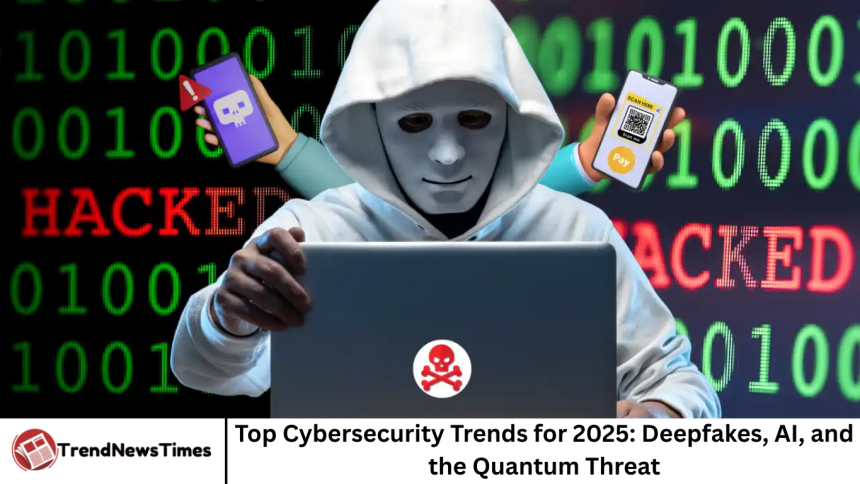
As we step deeper into the digital age, 2025 is shaping up to be a pivotal year for cybersecurity. The threat landscape is evolving at lightning speed, spurred by rapid advancements in artificial intelligence (AI), deepfake technology, and the long-anticipated rise of quantum computing.
Businesses, governments, and individuals alike are grappling with increasingly sophisticated cyberattacks that are harder to detect, prevent, and recover from. While traditional threats like ransomware and phishing remain active, a new breed of digital menaces has emerged.
Deepfakes are being used to impersonate CEOs and manipulate political discourse. AI, once a defensive tool, is now being weaponized by cybercriminals. Meanwhile, quantum computing threatens to crack the very foundation of modern encryption.
More Read: Luigi Mangione to Moo Deng: The Viral Faces of 2024
Deepfakes: The New Face of Cyber Deception
Deepfakes—AI-generated audio, video, or images that mimic real people—have taken a sharp turn into the world of cybercrime. Initially created for entertainment and satire, these forgeries now pose real security threats.
The Threat Landscape
In 2025, deepfake technology is being deployed for:
- Business Email Compromise (BEC): Cybercriminals use deepfake voice or video to impersonate executives, tricking employees into approving fraudulent wire transfers.
- Political Disinformation: Fake speeches or press releases can manipulate public opinion or incite unrest.
- Social Engineering: Personalized video scams targeting employees, customers, or investors.
Notable Incidents
A high-profile case in early 2025 involved a multinational CEO whose deepfaked voice was used in a phone call, authorizing a $38 million transaction. The incident shocked the business world and emphasized how indistinguishable fakes have become.
Countermeasures
- Use multi-layered verification for financial approvals.
- Train staff to recognize social engineering tactics.
- Invest in deepfake detection tools that scan video/audio content for inconsistencies.
AI in Cybersecurity: Double-Edged Sword
AI has become an integral part of modern cybersecurity. It can detect anomalies, predict breaches, and automate response efforts. However, the same technology is being weaponized by cybercriminals.
AI for Good
Security vendors are now deploying AI for:
- Behavioral analytics: Detecting suspicious activity based on user behavior.
- Threat hunting: AI-driven tools proactively search for vulnerabilities.
- Incident response: Automated systems can isolate threats within seconds.
AI for Bad
Cybercriminals use AI to:
- Automate phishing emails that are highly personalized and convincing.
- Scan code for vulnerabilities at scale.
- Bypass CAPTCHA and biometric systems.
Emerging Trend: AI vs. AI
We’re witnessing a digital arms race where AI security tools battle against AI-driven attacks in real-time.
What Organizations Should Do
- Partner with AI-savvy cybersecurity vendors.
- Regularly update algorithms and models.
- Conduct adversarial AI testing to ensure defenses can withstand AI-generated threats.
Quantum Computing: A Looming Threat to Encryption
Quantum computing has long been a theoretical concern for cybersecurity, but in 2025, its threat has become real.
Why Quantum Matters
Traditional encryption relies on mathematical problems that take classical computers years to solve. Quantum computers, using qubits and parallel processing, can break these encryptions in minutes.
Post-Quantum Cryptography (PQC)
To counter this, organizations are moving toward quantum-resistant algorithms. The U.S. National Institute of Standards and Technology (NIST) has already approved several PQC algorithms.
Industries at Risk
- Finance: Banks are a prime target due to sensitive transactional data.
- Healthcare: Patient records and drug formulas are valuable.
- Defense and Government: National security relies on unbreakable encryption.
Preparation Steps
- Audit current cryptographic systems.
- Begin transitioning to post-quantum encryption standards.
- Monitor developments from NIST and other global bodies.
Zero Trust Architecture Goes Mainstream
Zero Trust—an approach where no one is trusted by default—has shifted from theory to necessity in 2025.
Why It’s Crucial Now
- Remote and hybrid work continues to expand attack surfaces.
- Insider threats are increasing, both intentionally and unintentionally.
- Cloud and mobile-first environments require more robust access controls.
Core Principles
- Least privilege access: Users only get the minimum permissions needed.
- Continuous monitoring: Behavior is always under review.
- Never trust, always verify.
Real-World Adoption
Major corporations and government agencies have adopted Zero Trust as the core of their cybersecurity strategy, integrating tools like:
- Identity and Access Management (IAM)
- Multi-Factor Authentication (MFA)
- Microsegmentation
The Rise of AI-Powered Phishing Attacks
Phishing isn’t going away. In fact, it’s becoming even harder to detect thanks to generative AI.
Smarter Scams
- Context-aware: Pulling data from social media and public records.
- Emotionally manipulative: Designed using psychological triggers.
- Flawlessly written: Grammar and tone match the target’s expectations.
New Channels
Voice phishing (vishing) and deepfake video messages are growing. AI-generated voicemails or video calls can trick even seasoned professionals.
Defense Mechanisms
- Use natural language processing (NLP) filters to detect AI-generated messages.
- Train employees with realistic phishing simulations.
- Employ browser-based isolation to reduce impact if links are clicked.
Cloud Security: Addressing New Vulnerabilities
As more organizations migrate to the cloud, the attack surface broadens.
Common Threats in 2025
- Misconfigured cloud storage remains a top vulnerability.
- API attacks: Exploiting insecure interfaces used by cloud apps.
- Insider threats: Employees with excessive access rights.
The Shared Responsibility Model
Organizations are learning that cloud providers secure the infrastructure, but data and application security remain their responsibility.
Top Solutions
- Cloud Security Posture Management (CSPM) tools.
- End-to-end encryption of data in motion and at rest.
- Automated compliance monitoring for regulations like GDPR and HIPAA.
Cybersecurity Regulations and Global Cooperation
2025 marks a year of increased regulation and international collaboration on cybersecurity.
New Laws and Frameworks
- The EU Cyber Resilience Act sets stricter standards for connected devices.
- The U.S. National Cybersecurity Strategy requires incident reporting within 72 hours.
- India’s Digital Personal Data Protection Act (DPDPA) has reshaped data privacy norms.
Public-Private Partnerships
Governments are collaborating with tech giants to:
- Share threat intelligence in real time.
- Conduct joint cyber drills.
- Develop secure-by-design software standards.
Cyber Diplomacy
Increased cyberattacks on infrastructure have led to UN-led efforts to establish digital warfare norms and protections for civilians.
Frequently Asked Question
What is the biggest cybersecurity threat in 2025?
The top threats are deepfakes used for impersonation, AI-driven phishing attacks, and the emerging risk of quantum computing breaking encryption.
How is AI changing cybersecurity?
AI is a double-edged sword. It improves threat detection and automation, but it’s also used by cybercriminals to generate sophisticated attacks and evade detection.
Why is quantum computing a cybersecurity concern?
Quantum computers can solve complex problems faster than classical computers, potentially breaking widely used encryption methods and compromising sensitive data.
What is Zero Trust, and why is it important?
Zero Trust is a security model that requires continuous verification of users and devices. It’s critical in 2025 due to remote work, cloud computing, and insider threats.
Are deepfakes really a serious security issue?
Yes. Deepfakes are now being used to impersonate executives, manipulate public figures, and carry out fraud, making them a serious cybersecurity concern.
How can companies prepare for post-quantum threats?
Companies should begin migrating to post-quantum cryptographic algorithms and follow NIST guidelines for implementing quantum-resistant security.
What should small businesses focus on in 2025 for cybersecurity?
Small businesses should prioritize cloud security, employee training, MFA, and staying updated on phishing trends, especially AI-generated attacks.
Conclusion
Cybersecurity in 2025 is no longer just about firewalls and antivirus software. It’s a battlefield where AI combats AI, deepfakes undermine trust, and quantum computers threaten to crack open our digital vaults. Organizations must adapt with advanced tools, new mindsets like Zero Trust, and proactive threat intelligence. The time to act is now. Those who lag in cybersecurity readiness won’t just face data breaches—they’ll face legal, reputational, and operational collapse.